
Rounded Shoulders vs Kyphosis: Understanding Upper-Back Rounding

Rounded shoulders describe the position of the shoulders; kyphosis describes the outward rounding of the thoracic spine when viewed from the side. They can appear together, but they are not the same finding. Understanding the difference helps you decide whether the concern is a flexible position, a persistent spinal curve or a symptom that needs assessment.
The upper back naturally has some outward rounding. Clinicians often use “kyphosis” to discuss an excessive curve, while “hyperkyphosis” is the more precise term for increased rounding. A slightly curved upper back is not automatically abnormal.

Shoulder position and spinal shape are different
| Term | What it describes | What appearance alone cannot tell you |
|---|---|---|
| Rounded shoulders | Shoulders resting farther forward around the chest | Whether there is an abnormal spinal curve |
| Postural kyphosis | Increased upper-back rounding with a flexible, nonstructural component | The cause of any pain or the most useful treatment |
| Structural kyphosis | A curve associated with changes in spinal structure | The exact cause, severity or need for bracing |
A person can bring the shoulders back while the spine remains rounded, or change the upper-back position without strongly pulling the shoulders. This is why a shoulder strap and a spinal treatment plan address different things.
Flexible rounding versus a structural curve
The Scoliosis Research Society distinguishes flexible postural kyphosis from structural causes involving the spinal bones. A flexible curve may reduce when the person changes position. Structural curves tend to be less correctable by simply standing taller.
This distinction is useful, but it is not a home diagnostic test. Pain, stiffness and how you perform a movement can change what you see. Do not force your back flat against a wall or ask someone to push on it to find out which type you have.
In adolescents, Scheuermann's kyphosis is a structural condition in which several vertebrae become wedge-shaped. It is different from a temporary slouch. Congenital kyphosis begins with differences in spinal development before birth. The diagnosis and follow-up depend on the individual condition and remaining growth.
Why upper-back rounding may change with age
In adults, changes can relate to spinal degeneration, previous injury or vertebral compression fractures associated with osteoporosis. A new increase in rounding or loss of height should therefore not automatically be attributed to “bad posture.” MedlinePlus describes these among the possible causes that an assessment considers.
This does not mean everyone with a rounded back has a fracture. It means the timing matters. A long-standing, comfortable shape is a different story from a recent change accompanied by pain or reduced function.
Symptoms worth describing clearly
Some people have a noticeable curve with little or no discomfort. Others experience stiffness, back ache or fatigue during activities. A severe curve can occasionally affect breathing, but that is a complication of significant spinal deformity, not a conclusion to draw from ordinary rounded shoulders.
Write down what has changed: difficulty standing for a familiar task, a new painful spot, clothing fitting differently, or a concern noticed during growth. Note whether the appearance changes when you relax or move. Bring this information to an appointment instead of trying to assign yourself a curve measurement from a photograph.
How a clinician evaluates upper-back rounding
An evaluation usually includes the history, an examination of the back and a check of movement and flexibility. Depending on the findings, strength, sensation and reflexes may also be assessed. X-rays can show vertebral shape and measure a curve when imaging is appropriate.
Additional tests answer specific questions. For example, bone-density testing may be considered when osteoporosis is a concern; MRI is reserved for situations that require more information about the spine or nerves. Not everyone with rounded shoulders needs every test.
Seek assessment for a growing child with a persistent curve, an adult with a new or increasing change, or pain that is worsening or limiting daily life. New weakness, significant breathing difficulty or severe symptoms after an injury require prompt medical attention.
What treatment aims to improve
The plan depends on cause, symptoms, curve behavior and age. For a flexible posture-related concern, the focus may include comfortable movement, strength and changing habits that make activities difficult. For a structural condition, goals can include pain control, function and monitoring whether the curve progresses.
Exercises can help mobility, strength and symptoms, but should not be advertised as reshaping wedge-shaped vertebrae. Similarly, surgery is not the default for every visible curve. NHS guidance describes treatment decisions based on severity and problems caused by the condition.
Posture correctors and prescribed braces
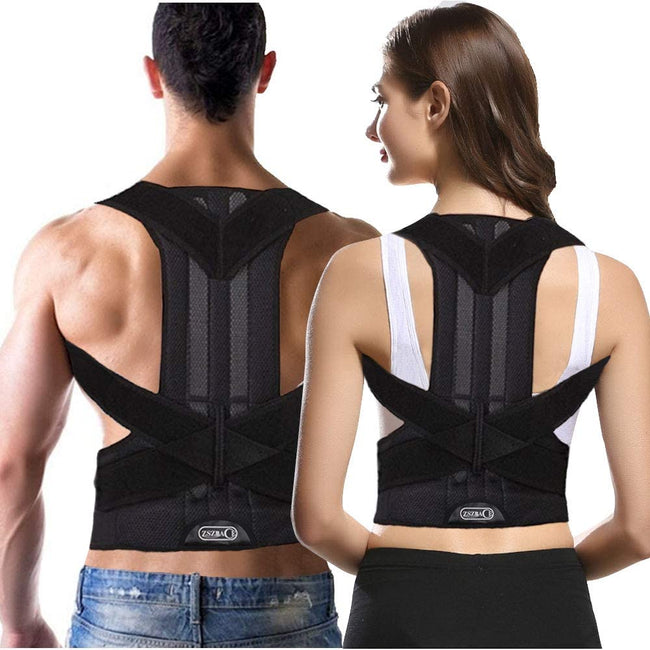
A retail shoulder or full-back posture support may offer a reminder of body position. It is not equivalent to an individually prescribed kyphosis brace. In selected children or adolescents who are still growing, a specialist may recommend bracing for Scheuermann's kyphosis and supervise the wearing plan.
If you are browsing posture corrector braces for ordinary position awareness, keep that purpose separate from treatment of a diagnosed spinal curve. Product coverage, metal stays or the words “full back” do not establish that it can treat structural kyphosis.
Frequently asked questions
Do rounded shoulders mean I have kyphosis?
No. Shoulder position and spinal curvature can overlap, but one does not diagnose the other. Persistent or changing rounding is best assessed in context.
Can I tell the difference by standing straight?
How flexible the shape appears is useful information, but it is only one part of an examination. Do not use a mirror test to rule out a structural condition.
Will a posture corrector straighten a rigid curve?
A retail posture corrector cannot be assumed to change a structural curve. Appropriate clinical braces have specific indications, fitting requirements and follow-up.
Is a “neck hump” always kyphosis?
No. That everyday phrase can refer to different contours or tissue changes around the lower neck and upper back. A new or enlarging prominence should be examined rather than treated from its appearance alone.
Should I avoid exercise if my upper back is rounded?
Not automatically. Activity can remain valuable, with the type and intensity adapted to your condition. If you have a diagnosed curve, osteoporosis, pain or a recent change, ask for guidance on a suitable program.
Sources and further reading
Products mentioned in this guide
Product details
Full Back Brace Posture Corrector with Cross Straps & Adjustable Waist Belt
Breathable mesh comfort
$44.99 USD
View sizes & details