
De Quervain's: Thumb-Side Wrist Pain and Support Choices

Pain on the thumb side of your wrist can make lifting a child, pouring from a kettle or twisting a lid unexpectedly difficult. De Quervain's tenosynovitis affects the tendons that move the thumb. The useful first step is to identify the painful movements and choose support that covers the right area.
What happens in De Quervain's?
Two thumb tendons travel through a narrow passage at the wrist. Irritation and thickening around this passage can make their movement painful. According to the American Academy of Orthopaedic Surgeons, the exact cause is not fully understood. Repeated thumb and wrist movements can aggravate it, and it is associated with pregnancy and the period after childbirth.
Typical symptoms include tenderness or swelling on the thumb side of the wrist, pain with gripping or twisting, and sometimes a catching sensation. Discomfort may extend toward the thumb or forearm. This differs from arthritis centered in the thumb-base joint; our thumb arthritis guide explains that distinction.
How do clinicians confirm the problem?
Your clinician reviews your symptoms, recent activity changes and injury history, then examines the wrist and thumb. They may use a guided movement test to check the involved tendons. Imaging is often unnecessary but can help when another condition needs to be excluded. Repeatedly forcing a painful self-test is less useful than describing where and when the symptoms occur.
What does treatment usually involve?
Berkshire Healthcare NHS guidance emphasizes modifying irritating tasks, using a suitable thumb-spica support and gradually returning to appropriate exercise. Relative rest means reducing the movements that provoke symptoms; it does not require abandoning every activity. A wrapped cold pack may help discomfort, while a pharmacist can advise on appropriate pain relief. Avoid applying ice directly to the skin.
A therapist can help you find less aggravating ways to use the hand and guide exercise as symptoms settle. If pain persists, a corticosteroid injection may be offered. Continuing exactly the same irritating workload can undermine progress, so support and task changes need to work together.
For ongoing symptoms, a hand specialist may discuss releasing the tight tendon sheath surgically. North Tees and Hartlepool NHS information explains the progression from self-management to specialist treatment and hand therapy. Recovery plans and splint schedules vary; use the schedule prescribed for your situation rather than a universal number of hours.
Why wrist-and-thumb coverage matters
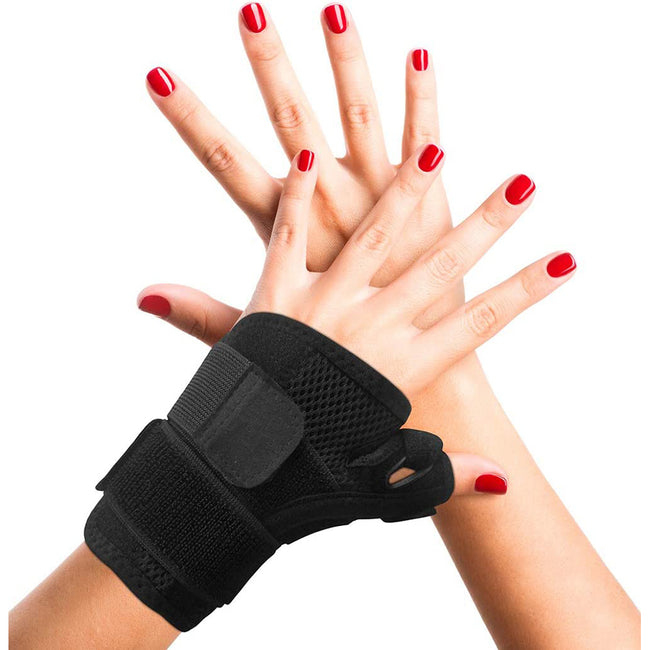
A thumb-spica design supports the thumb as well as the wrist. That is different from a wrist strap that leaves the thumb moving freely, or a compact CMC brace primarily focused on thumb-base arthritis. The aim is to reduce the movement that irritates the tendons while the area settles. A supportive feel alone does not establish that the fit or design is appropriate.
- Look at the thumb section: Does it provide actual support, or only an opening for the thumb?
- Look at wrist control: A clinician may recommend a design that keeps the wrist comfortably straight.
- Check size and side: Use the product's own chart and confirm left, right or reversible construction.
- Check daily practicality: Consider removable components, washing instructions and how easily you can adjust the straps.
Browse our thumb and wrist supports or inspect this thumb-support option. Choose it only if its actual construction matches the support your wrist and thumb need; softer compression styles are not interchangeable with a structured splint.
Apply the plan to your day
During baby care, ask a therapist to review the lifting position that triggers pain. For work or hobbies, identify the repeated grip or twist rather than blaming every movement. During desk tasks, notice whether phone use or reaching repeatedly reproduces the same discomfort. Keep a short list of the hardest tasks to discuss at review.
Before buying, write down the coverage you need, your measurements and the times you expect to wear the support. This makes comparison more useful than picking the most rigid-looking product and hoping it will suit every activity.
When to seek assessment
Get checked when symptoms persist, recur or interfere with normal activities. New tingling or numbness also needs attention. For severe pain, loss of sensation, a visibly changed thumb or inability to move it after injury, seek urgent care, as outlined in NHS thumb-pain guidance.
Sources and further reading
Written by the ZSZBACE editorial team. Sources checked November 2026.
Products mentioned in this guide
Product details
Thumb Spica Brace for Arthritis, Tendonitis & Everyday Thumb Pain
Focused support for a sore thumb
$22.00 USD
View sizes & details