
Thumb Arthritis: CMC Support and Easier Everyday Tasks

When turning a key, opening a jar or holding a pen makes the base of your thumb ache, even small jobs can become frustrating. Thumb-base osteoarthritis is one possible explanation. Understanding which joint hurts—and how your hand is being used—helps you choose useful changes, exercises and support.
What is thumb-base arthritis?
The carpometacarpal, or CMC, joint sits where the thumb meets the wrist. Its mobility lets the thumb turn toward the fingers for gripping and pinching. Osteoarthritis involves changes to the cartilage and other joint structures. It becomes more common with age; previous injury, family history and joint looseness can also contribute. The American Academy of Orthopaedic Surgeons describes pain, swelling, reduced grip strength and difficulty moving the thumb among the possible symptoms.
Discomfort often develops gradually and is more noticeable with pinching or twisting. Some people have a visible prominence at the thumb base. An X-ray showing arthritis does not, by itself, tell you how much pain or difficulty someone experiences.
How is it diagnosed?
A clinician asks about your activities and symptoms, examines the thumb's movement and tenderness, and may request X-rays. Other problems can affect this area too. Pain along the thumb side of the wrist may involve tendons, as described in our De Quervain's guide. Tingling or numbness deserves separate attention; see our carpal tunnel overview.
What treatment can help?
Management usually begins with ways to reduce painful loading while keeping the hand useful. The British Society for Surgery of the Hand describes a combination of activity changes, suitable pain relief and splinting. A pharmacist or clinician can advise whether a topical or oral medicine is appropriate for you. Hand therapy can help you work on movement, strength and task adaptations.
If symptoms remain troublesome, a corticosteroid injection may be considered; its benefit can be temporary. Surgery is an option for selected people whose symptoms remain limiting despite nonsurgical care. Several procedures exist, so the decision depends on the joint, your function and a hand surgeon's assessment. A brace is one part of symptom management; it does not rebuild joint cartilage.
Which thumb support should you compare?
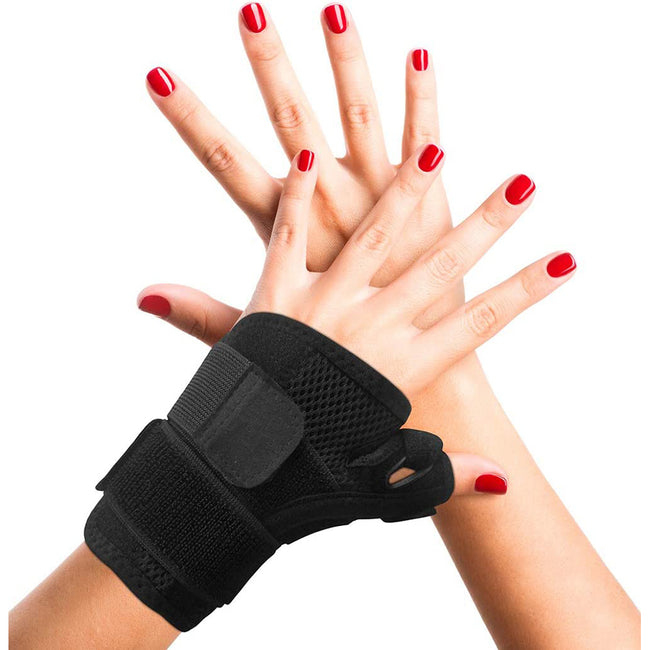
A thumb-base support needs to act around the CMC joint. A narrow wristband that leaves the thumb unsupported serves a different purpose. Soft wraps can be practical when you still need to handle everyday objects; a more structured CMC brace provides a different level of movement control. Some people are advised to use a firmer resting splint at night. Kingston and Richmond NHS guidance discusses both everyday supports and resting splints.
- Check coverage: Look for a thumb-base design, not simply the word “hand” on the label.
- Check fit: Follow that model's measurements and left/right selection. The edge should not dig into the space between thumb and finger.
- Check your task: Consider whether you need to write, wash your hands frequently or use tools while wearing it.
Compare our thumb support options and the construction of this adjustable thumb support with wrist coverage. This model adds wrist coverage; it is not a compact CMC-only brace. Match the actual coverage to your care plan rather than choosing solely by thickness or appearance.
Make everyday tasks easier
Try a jar opener or non-slip mat instead of a forceful fingertip grip. Larger pen and utensil handles may feel easier to hold. Use both hands to support heavier objects, and split long cooking, gardening or craft sessions into shorter blocks. These changes can work alongside a brace.
Choose one troublesome task to assess first. Note whether a different grip, shorter session or appropriately fitted support makes it easier. This gives your therapist something concrete to discuss, without expecting one product to solve every hand problem.
When should you get help?
Arrange an assessment if pain keeps returning, limits normal tasks or does not improve with self-care. The NHS advises urgent assessment for severe pain, a changed thumb shape or color, loss of feeling, or inability to move the thumb or hold objects, particularly following injury.
Sources and further reading
Written by the ZSZBACE editorial team. Sources checked November 2026.
Products mentioned in this guide
Product details
Thumb Spica Brace for Arthritis, Tendonitis & Everyday Thumb Pain
Focused support for a sore thumb
$22.00 USD
View sizes & details