Shoulder recovery and support selection
Read how a sling’s positioning role differs from a soft shoulder wrap, and why prescribed rehabilitation instructions matter.



In stock
Couldn't load pickup availability


EVERYDAY SUPPORT
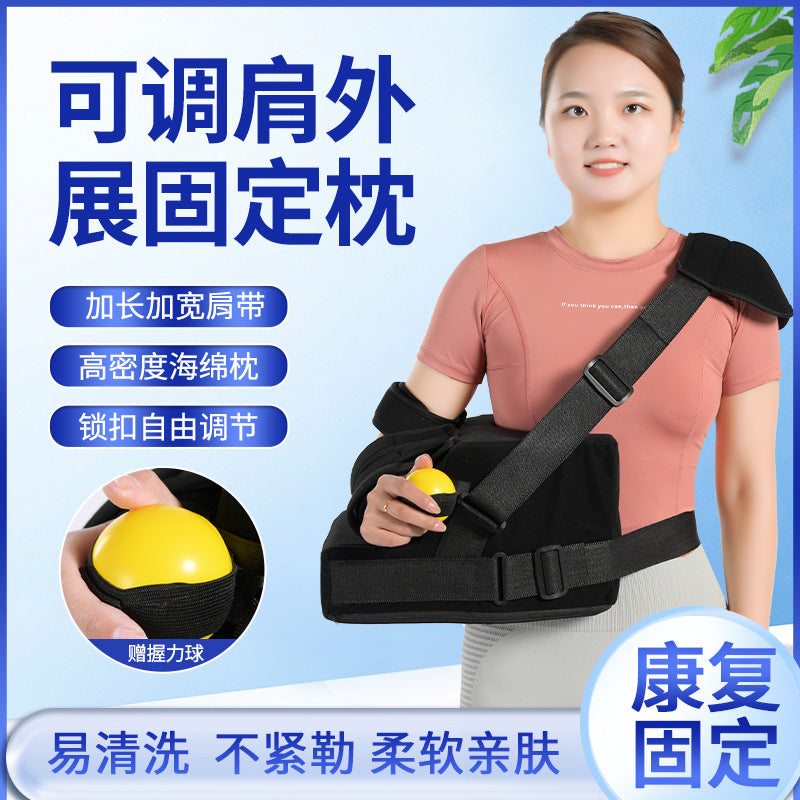
The forearm pouch supports the arm in the specified position. Shoulder and waist straps secure the assembly together. Use the sling for the position and schedule given in the care plan.

FIT & CONSTRUCTION
The cushion, sling and body straps are intended to work together. Use the exact configuration and arm position prescribed for the injury or procedure; do not change the cushion angle to make it look like another product. A positioning cushion separates the arm from the torso as instructed.

Use this model’s forearm, body and strap measurements. Confirm the required arm position and adjust the pouch height without pulling the shoulder upward.
Forearm and elbow, with a shoulder strap and any specified waist anchor.
Choose this style when you need an arm-pouch construction rather than a shoulder wrap.
| Detail | Specification |
|---|---|
| Design | Shoulder Support Sling with Abduction Cushion |
| Coverage | Forearm and elbow, with a shoulder strap and any specified waist anchor |
| Construction | Forearm pouch, Waist panel, Shoulder strap, Positioning cushion |
Check forearm length and whether the option is for a child or adult. Follow the supplied fitting guidance for arm position and any abduction cushion.
Need help with fit? Contact us with your measurements and the option you are considering before ordering.
Check the selected size, color, side and quantity before adding to cart. Photos may show more than one option.
Forearm sling support with an additional positioning cushion.
The arm pouch carries the forearm while the strap sets its position. Compare pouch length, strap routing and any waist anchor when choosing between a simple sling and a more structured support.

Close all closures. Remove stays or inserts only if the product instructions identify them as removable; do not pull out sewn-in supports. For washable textile parts, hand wash in cool or lukewarm water with mild soap and air-dry away from direct heat. Do not bleach, tumble-dry or iron. Clean fixed supports as directed by the care label.
Use these guides to compare the options or prepare for fitting and everyday care.
Check checkout for the delivery estimate for your address and selected option. See our shipping policy for details. If the size is not right, review the return policy and contact us before sending the item back.
Read how a sling’s positioning role differs from a soft shoulder wrap, and why prescribed rehabilitation instructions matter.
Use the sling for the position and schedule given in the care plan.
Check fastenings and arm placement before standing or walking; follow any guidance for removing the support.
Close hook-and-loop tabs before washing. Hand wash washable fabric with mild soap and air-dry away from direct heat. Follow the care label and remove components only as instructed.
Use the position prescribed for your injury or procedure. Sling height, cushion placement and wear time depend on that plan.
Follow the care schedule, including any allowed movement or exercise breaks. Do not borrow a timetable from a different condition.
Compare the forearm pouch dimensions and the strap/body range in this model’s guide. An adult and a child sling are not interchangeable just because the strap adjusts.
Understand the symptoms, common causes, treatment options and the role of a suitable support.
Use a supported arm position when your clinician has prescribed a shoulder abduction sling. This design combines a forearm pouch, positioning cushion and body straps so the components work together. Confirm the required support configuration, then fit it according to your postoperative or injury-care instructions.
Free standard shipping on orders $15+
After discounts.
45-day refund request window from delivery. See refund details.
Explore product details and guides, or ask our team for help before ordering.