
How to Protect Your Knees When Lifting Heavy
If you lift heavy, your knees take on a lot of work. That does not mean knee pain is inevitable. In many cases, better setup, stronger supporting muscles, smarter training volume, and the right protective gear can help you train more confidently and with better control.
This guide covers practical ways to protect your knees during heavy lifting, especially for squats, leg training, and strength-focused workouts.
Why knees get stressed during heavy lifts
Your knees are asked to handle force, stabilize your position, and stay aligned while your hips, ankles, and feet all work together. Problems often show up when one of those pieces falls out of place.
Common reasons lifters feel excess knee stress include:
- Letting technique break down as the weight gets heavier
- Weak or undertrained quads, glutes, or hamstrings
- Poor ankle or hip mobility that changes squat mechanics
- Too much volume or intensity without enough recovery
- Using supportive gear as a substitute for good movement habits
The goal is not to remove all stress from the knee. The goal is to build strength and stability so your knees can handle training demands more efficiently.
5 practical ways to protect your knees
1. Build strong legs, not just a bigger squat
Stronger thigh and hip muscles help support the knee during heavy work. Quads matter, but so do glutes, hamstrings, and calves. If your training is overly focused on one movement pattern, your knees may end up taking more strain than they should.
Useful accessories may include controlled split squats, step-ups, leg curls, paused squats, and tempo work that helps you own the full range of motion.
2. Pay attention to knee posture and tracking
During squats and leg presses, your knees should generally track in line with your feet. A little movement variation is normal, but if your knees constantly collapse inward or shift unevenly under load, it is worth addressing before adding more weight.
Cues that often help:
- Set your feet before unracking the bar
- Keep pressure balanced through the foot
- Let the knees travel naturally instead of forcing an unnatural position
- Control the descent instead of dropping too fast
- Keep your torso braced so the lower body can stay organized
3. Use a range of motion you can control
Depth matters, but controlled depth matters more. If you lose position at the bottom of a squat, your knees may end up compensating for weakness, poor bracing, or limited mobility elsewhere. Work within a range you can own, then build from there.
4. Avoid overtraining
Heavy training works best when recovery keeps up. If your knees feel beat up every week, look at your total squat volume, exercise selection, rest days, and sleep habits. Sometimes the fix is not a new cue. It is better programming.
Signs you may need to adjust:
- Knee soreness that lingers session to session
- Sharp discomfort during warm-ups
- Technique getting worse every set
- Performance dropping while fatigue stays high
5. Use supportive gear when it fits the session
Protective gear can be helpful during heavy training, especially when you want more support and a more secure feel around the joint. That said, gear should support good mechanics, not replace them.
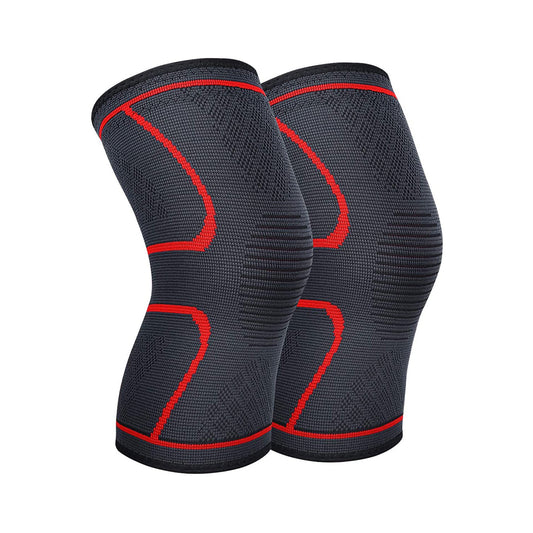
Knee wraps are commonly used by strength athletes during high-intensity squat work because they add compression and support around the knee. Many lifters like them most for top sets, heavy singles, or competition-style sessions rather than every rep of every workout.

Knee Wraps
Extra support and compression for heavy lower-body sessions.
Good fit for lifters who want more confidence during hard squat sets.
Common mistakes that can make knee discomfort worse
- Jumping weights too quickly: Rapid load increases can expose weak points in technique and recovery.
- Ignoring warm-ups: A few ramp-up sets can help you find better positions before the work gets heavy.
- Forcing one squat style: Not every lifter will use the same stance, toe angle, or bar position.
- Relying only on gear: Wraps and belts can help, but they work best on top of solid fundamentals.
- Training through sharp pain: Discomfort is feedback. Do not ignore it.
When knee wraps may make sense
Knee wraps may be worth considering if you:
- Train heavy squats or powerlifting-style sessions
- Want a tighter, more supported feeling around the knee
- Need support for top sets while keeping your own movement pattern consistent
- Already have a solid base of technique and leg strength
If you are newer to lifting, focus first on position, bracing, and gradual progression. Supportive gear is usually most useful once your training is already structured and consistent.
Final takeaway
To protect your knees and keep progressing, focus on the basics first: strong legs, controlled technique, balanced movement, and enough recovery. Then, if your training style calls for it, supportive gear like knee wraps can be a helpful addition for heavy sessions.
The best approach is simple: lift with control, recover on purpose, and use support tools strategically.
FAQ
Can knee wraps help you lift more weight?
Some lifters use knee wraps during heavy squats because they prefer the added support and rebound-like feel. They are not a substitute for strength or technique, but they can be useful in high-intensity training.
Do knee wraps protect your knees?
They can provide compression and support during lifting, which may help some athletes feel more stable under load. Proper programming, posture, and recovery still matter most.
Should beginners use knee wraps?
Most beginners should spend more time building movement quality, leg strength, and consistency first. Knee wraps tend to make more sense for heavier or more advanced training.
What is the biggest mistake lifters make with knee pain?
One of the biggest mistakes is trying to push through worsening symptoms without changing load, volume, or technique. Small adjustments early are often better than long layoffs later.